simple is beautiful
Barcelona Photoblog: history
2 ... 2 ...
Showing posts with label history. Show all posts

Saturday, September 20, 2008

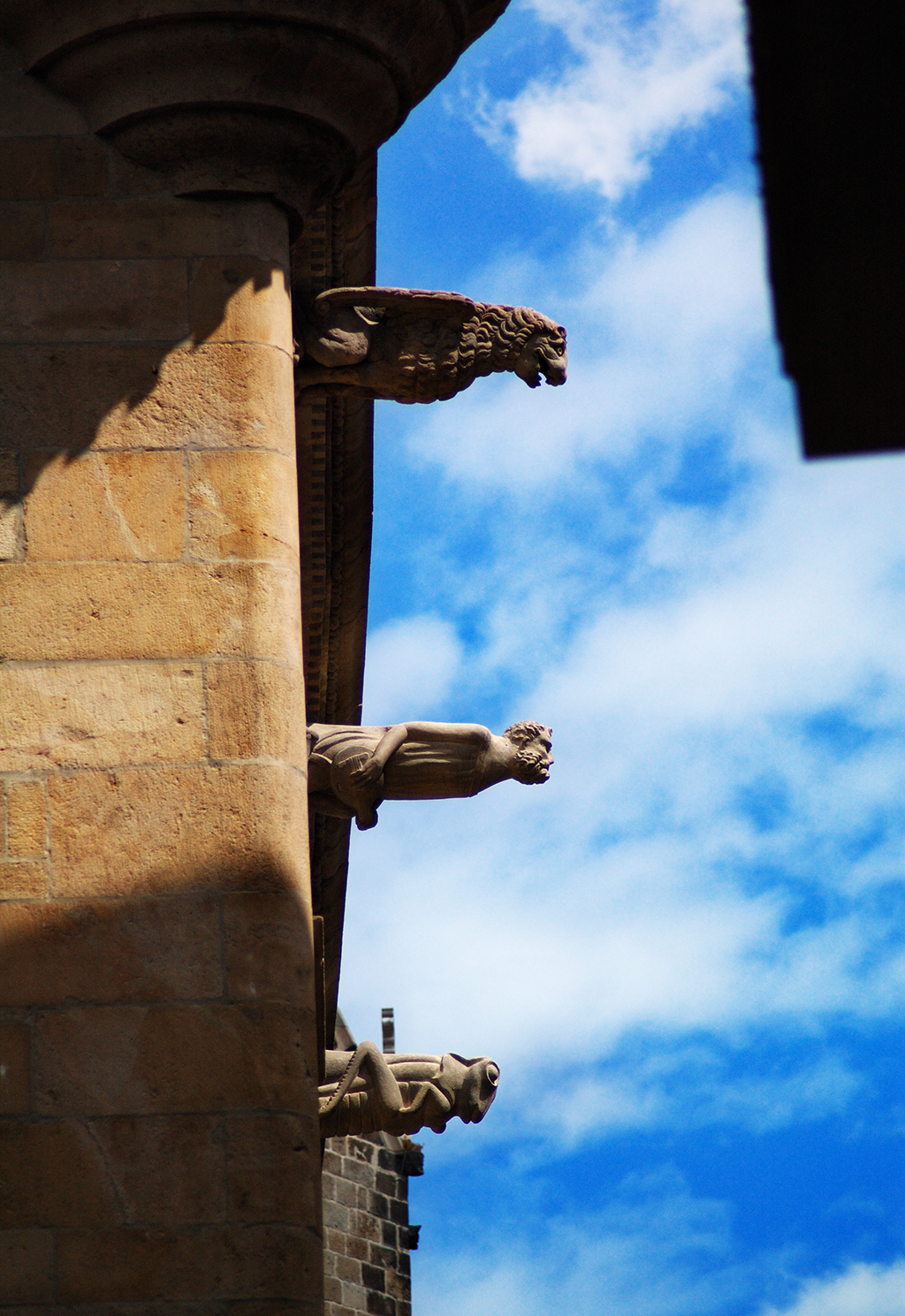
The Gargoyles of Death, Plaza del Rey, Barcelona

The Gargoyles of Death, Plaza del Rey, Barcelona [enlarge]

Half-bred uncanny creatures, stalking from above and ominously spitting rivers of water as if announcing the downfall of man and the arrival of an ignote, unfathomed gloomy world. Sunday morning on your way to church. A long, long time ago. You have a sudden urge to pray. Things are not going too well lately. Mysterious deaths scamper through the city. Hundreds, perhaps thousands of people are doomed by now and nobody knows why. Is it God's wrath? Is it one of the seven plagues? Some say it comes in the air or that it dwells in the pestilent waters of the outskirts. Almighty God! What is that! A filthy rat!. Get out of my way, you abominable evil creature. I wonder why there are so many. Stop looking at me, you hideous gargoyles...In 1589 1/4 of the population in Barcelona, 12.000 to 13.000 approximately, succumbed to bubonic plague (via this article in Spanish). Here is a 3D Google SketchUp of Plaça del Rei.

Friday, September 19, 2008

The Art Nouveau Lamp in Barcelona, Europe

The Art Nouveau Lamp in Barcelona, Europe [enlarge]

Decorative arts, architecture and other forms of artistic expression lived an authentic ecclosion by the end of XIX and the first years of XX c. in Catalonia as part of a cultural and political movement known as Renaixença which was spurred by the new spirit of the wealthy local bourgeoisie and their quest for industrial expansion, the influence of Paris and other industrialized European countries as the new model to follow in opposition to the retrograde, stale Castilian yoke. The cultural side of this renaissance, this art nouveau and the way it manifested in Catalonia is called Modernisme. A lamp was just a lamp but all of sudden there was an urge for innovation and new trends, an outburst of creativity that said hey this is our art, it is Catalan, we borrowed some elements from the most modern and fashion countries in Europe and Asia, we improved it and lifted it to the category of divine, we are educated, passionate for art, powerful and basically we don't need your Royal Majesties anymore, in fact we never did. Of course this is history in a very personal and simplified way. Here is another modernist lamp.

Saturday, March 22, 2008

Obelisk at the Intersection of Passeig de Gracia and Diagonal, Barcelona, Spain

Obelisk at the Intersection of Passeig de Gracia and Diagonal, Barcelona, Spain [enlarge]

This obelisk you find at the intersection of two main arteries in Barcelona, Passeig de Gracia and Diagonal. Known as the Lápiz (the pencil) it is located on the center of a quite peculiar crossroad that goes by the name of Cinc d'Oros (Five of golds, that is, the golden coins, one of the suits in the Baraja Española or Spanish cards) due to four lamp posts that used to surround the monument. The sculpture represents Franco's victory and dates back from 1940 (I can't believe it is still there considering what it represents!). Well the woman was sculpted by Frederic Marès. It must be said that the original statue (1936), by Josep Viladomat, was dedicated to the Republic, the lady was wearing no robe and instead of being on the present pedestal it was standing on top of the obelisk. Most of all, I enjoyed the combination with the beautiful face in the background, thanks to that the Lápiz looks less boring.

Monday, December 17, 2007

Barcelona Coat of Arms

Barcelona Coat of Arms [enlarge]

Barcelona coat of arms can be appreciated on this lamp post located in Passeig de Lluis Companys near Arc de Triomf. The city coat of arms is a blend of the arms of the counts of Barcelona and the arms of Aragon. It was conceded to the city on July 4th 1345. The cross is that of St. George who is the patron saint of the city. In case you wonder what the lines mean (red on yellow in the flag and original coat of arms) you should know that the red ones stand for the blood that the French emperor Charles the Bald drew with the blood of the Count of Barcelona, Guifré el Pilós on the golden shield of the Count.

LABEL